
At 1.52pm on Monday, Dave Ryding finished his fifth and final Olympics. Such is the order they send these men slaloming down a hill, he crossed in gold medal position and so he signed off on his career with a little bow to the grandstand, predominantly loaded with Italians.
Judging from the way they roared back at him, it was never going to matter that he was in silver spot within three minutes and bronze inside six. Ditto that he was 17th when the music stopped an hour later.
‘Anywhere you go in places that follow this sport, Dave is everyone’s second favourite skier,’ Chemmy Alcott had told me a few moments prior to Ryding’s second run.
As a four-time Olympian for Team GB, Alcott knows this stuff, which is to say she is aware more than most that no one from these isles has achieved what Ryding has on a pair of skis.
He doesn’t leave the sport at the age of 39 with the ultimate prize of an Olympic gold, so on one level he has fallen short of the likes of Matt Weston, Tabitha Stoecker, Charlotte Bankes and Huw Nightingale from these Games alone. But he does go with something else – the utmost respect of the greats of Switzerland, Norway and Austria, which was hard earned and a different kind of conversation.
Alcott again: ‘That respect is a challenging thing for a British athlete to achieve. I remember at the beginning, people would say to me, ‘Are you the Eddie the Eagle of skiing?’ Eddie is great, but I don’t think people say things like that now and it’s because of what Dave’s done.’
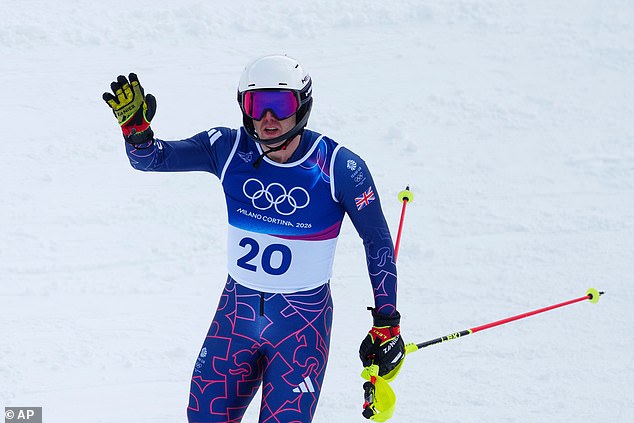
British skiing star Dave Ryding, 39, has bowed out after his fifth and final Winter Olympics
What has he done? Well, that’s a wonderful story, really. Because he was no ski baby, born into wealth in the mountains.
His mother was a hairdresser, his father a market trader selling ladies underwear, and the family lived in Lancashire. No snowy slopes, there, but they loved skiing – Ryder’s route started on a dry slope in Pendle and he didn’t train on the proper stuff until he was 13. For a taste of comparison, Switzerland’s Loic Meillard, who won the gold on Monday, started at two.
But Ryding stuck at it. No money for gear and trips, but he had heart. And there are tales to told about that – one of Ryding’s long-time associates shared an example with me on Sunday about his professional breakthrough at the Europa Cup in 2013.
The Swedes, who had the man to beat, were stunned when they saw Ryding waxing his own skis the night before the race. Their guy had a team of ski technicians and lost; Ryding won and gradually the Nordics and the Scandis stopped making their jokes. Indeed, Ryding told me a few years ago that he, too, had heard the one about Eddie the Eagle.
It was the perseverance they admired initially, and then the success. Top-20s became top-10s and they became top-fives. When he made his first World Cup podium on the iconic slopes of Kitzbuhel in 2017, it was the first Britain had won in skiing since 1981. Five years later, he won a World Cup gold, and eventually he collected seven top-threes.
So what weighs more? Gold in niche sports where a geographical disadvantages can be levelled with investment and technology? Or getting to the front in one where birthplace and funding truly matters?
Ryding had neither. And nor does he have an Olympic medal to show for it. His best finish at a Games was ninth, but ninth in the slalom and ninth in the skeleton are hardly the same thing. He was always too modest to put it in those terms, and come the end he was happy with his lot.
‘I have no regrets,’ he said. ‘I gave it my all until the last gate and I think that’s the sort of representation of my career. I know my story was totally unique.
‘I did it a totally different way and you probably say it was a one in a million shot. But I proved that you can do it.’