
Who was Jonah Lomu? Back in the day when he was tearing down the wing in the legendary All Black jersey of New Zealand, everybody thought they had the answer to that question.
For some, he was simply the ultimate rugby player. For others, he was the sport’s first global superstar. For England captain Will Carling, who had the misfortune to face him in the 1995 Rugby World Cup semi-final in South Africa, the All Black was ‘a freak of nature’.
Gavin Hastings, who had captained Scotland in defeat against New Zealand in the quarter-final, described him as ‘a big b*****d’.
Comedian Robin Williams once suggested Lomu was ‘K2 on legs’, while Nelson Mandela, during introductions before the 1995 World Cup final, told him: ‘You are the one’. Today, more than 30 years on from the tournament in South Africa where a 19-year-old Lomu announced his arrival as rugby’s brightest star, Gavin FitzGerald suggests that the 6ft 5in, 19st All Black was simply ‘a big, friendly giant’.
FitzGerald should know. He has spent the last few years making a film about the rugby superstar who died tragically young aged 40 in 2015. The film Lomu, which FitzGerald co-directed with Vea Mafile’o, will receive its UK premiere at the Glasgow Film Festival later this month. For Dublin-based FitzGerald, it has been a chance to honour one of his sporting heroes.
‘I was a big fan of Jonah growing up,’ he explains. ‘I was very young watching the ’95 World Cup. That was my first memory of sport. There was so much buzz around this guy and, as a young boy, you fantasised about being this person who was invincible, who people bounced off when they tried to tackle him. Jonah was just a superstar.’
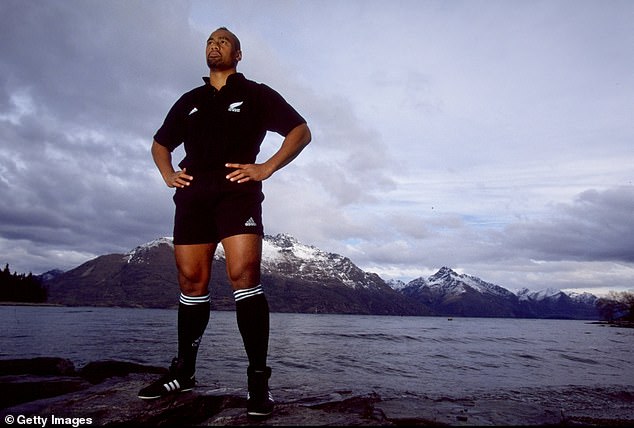
Jonah Lomu was an imposing figure and an incredible athlete for the All Blacks
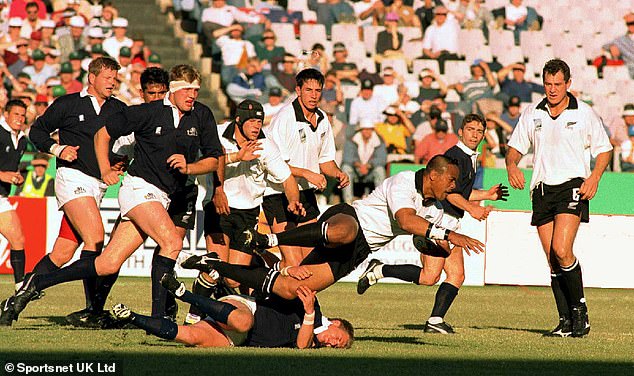
Lomu burst on to the scene in the 1995 Rugby World Cup, trampling over Scotland in a quarter-final victory
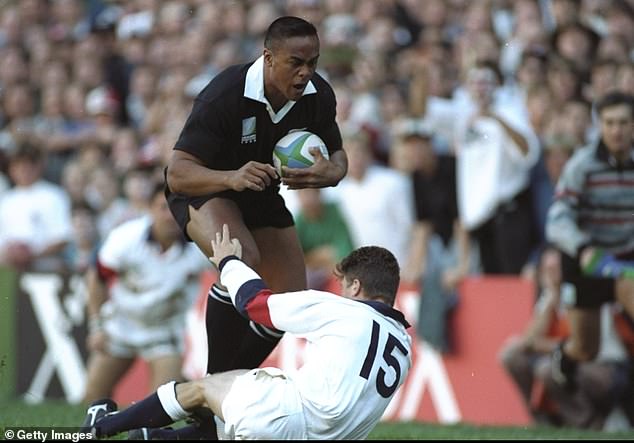
Lomu then famously did the same to England in the semi-final, running through Mike Catt
He was also human. The story FitzGerald tells in Lomu is not only about sport but about a man who at times struggled with relationships, with the exposure that came with his fame, and ultimately with his own body.
Lomu was diagnosed with a rare kidney disorder called nephrotic syndrome in 1995, the same year he announced himself to the world in South Africa. His rugby career was played out under its shadow. Which makes what he achieved all the more remarkable.
‘It’s testament to his mentality. His drive was exceptional,’ says FitzGerald. ‘He tended to keep things secret. Even his coaches had no idea he was carrying this very serious condition which inevitably would end up with him having a kidney transplant. You’d think he might mention it, but, no, he kept it to himself and got on with it.’
And how. To watch footage from the 1995 World Cup is to watch an athlete exploding onto the world stage. Lomu scored two tries in the first game against Ireland, another against Scotland in the quarter-final and then four against England in the semi-final. He didn’t so much run past the England players as run through them and over them.
‘That is the ultimate expression of power,’ FitzGerald suggests. ‘There’s something about watching this kid from a Pacific island just run over the people who made the game.
‘The English loved it as well. It was okay if Jonah ran over you. We loved it as well, the Irish, the Scottish. Everyone got destroyed by this guy and that’s why they’ve got so much love and affection for him. What do you do about this guy? Because he’s unstoppable.’
Well, he was up to a point. In the final, the lingering effects of food poisoning and a well organised Springboks side stopped Lomu and the All Black juggernaut in a game that did much to cement South Africa’s return to sporting acceptance.
In both sporting and cultural terms, it’s difficult to overstate how important the 1995 World Cup was. ‘It was an iconic tournament,’ FitzGerald says. ‘South Africa weren’t allowed to compete in the first World Cup because of apartheid. So South Africa are back in the tournament, and New Zealand just about picked this kid to come onboard. He really was close to not making that team. Everything seemed to come together for him. He was just let loose and the tournament just built and built and built.
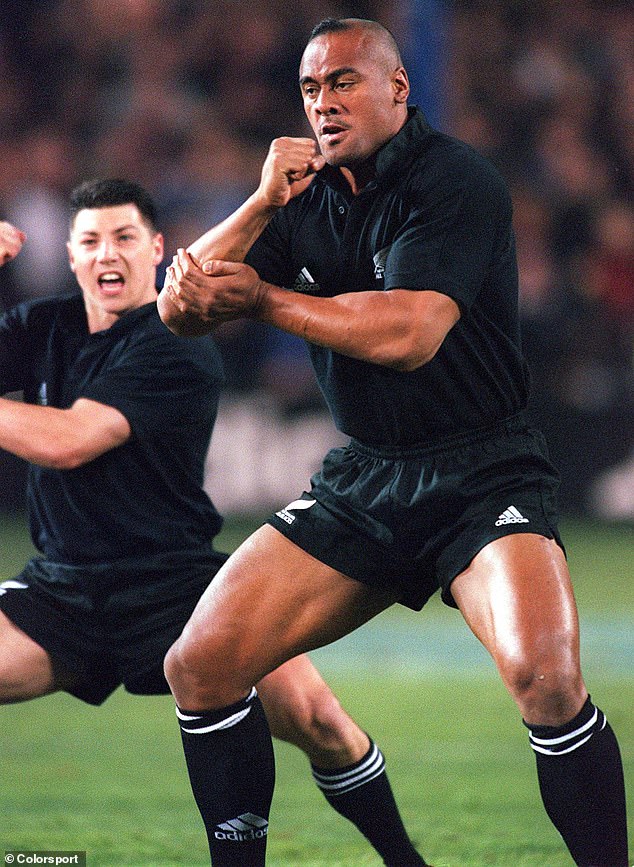
Lomu looked to be on course for world domination but health issues then blighted his career
‘It was the dawn of professional rugby. It was going to go professional soon, but Jonah’s presence undoubtedly accelerated that.’
Four years later in the 1999 World Cup in the UK, a Lomu-fuelled All Blacks team would come up short again, losing in the semi-final to an inspired France. The All Blacks had raced into a 24-10 lead just after half time, thanks to two Lomu tries. However, Les Bleus turned it around in the second half to run out 43-31 winners.
By the time the 2003 World Cup rolled round, Lomu was on dialysis. A year later, he would undergo a kidney transplant. Although he would continue to play rugby until 2007, his time at the peak of the game burned brightly but briefly.
‘He never got the highs,’ FitzGerald admits. ‘Had he not been carrying this condition, who knows how many World Cups he would have played? He could have played five. He was good enough, but he was weighed down.’
Perhaps by more than just his condition. To go back to that question, ‘who was Jonah Lomu?’, you have to go back to the start of the story.
Lomu was born in Auckland in New Zealand in 1975 to Tongan parents. A year later, he was sent to live with his aunt in Tonga when his brother was born. To understand Lomu, FitzGerald suggests, you have to understand Tongan culture.
‘First of all, Tonga truly is a village,’ says FitzGerald. ‘It still operates like that. It’s all about the group.
‘In Tonga, it’s a very common thing if somebody in the family doesn’t have kids that they might be gifted a child to raise — in order to spread the workload essentially. But, of course, Jonah’s parents had emigrated. They are first-generation immigrants to New Zealand, so that’s an extra layer of complexity.
‘Also his mother had to work, so they couldn’t really maintain having two children at home when they had his brother.
‘Jonah had very rich memories of Tonga, his childhood. Food is plentiful, you live off the land and run wild. Then to be brought back to New Zealand, suddenly realising his “parents” weren’t his parents and living in a completely different environment … you can’t ignore that initial trauma. And you can see that boy in him at various stages of his life.’
By 14, Lomu already stood out as a sportsman. There is footage in FitzGerald’s film of a bare-chested Lomu towering above his contemporaries, with a six-pack that would normally need to be created by CGI.
‘It’s ridiculous. The abs, come on,’ FitzGerald says, laughing. ‘If you haven’t been to Tonga, there are a lot of big guys out there, but Jonah had that combination of power and speed. A once-in-a-generation athlete.’
After making his initial impact at the global showpiece in South Africa, he become hot property, turning up in adverts for everyone from McDonalds to Pizza Hut.
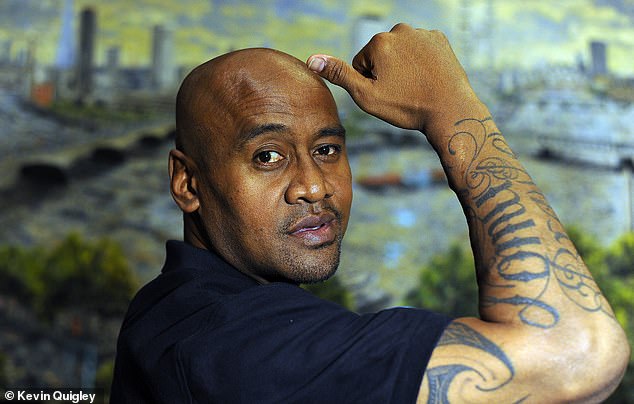
Lomu’s domestic life was also complicated, with the mighty winger married three times
Lomu started making a lot of money. And spending it, too. He had a love of fast cars for a start, one he continued to indulge even when he wasn’t earning (he ended his life virtually penniless.)
He also got married three times. His romantic life was turbulent, to say the least.
‘There’s a pattern to his relationships,’ FitzGerald points out. ‘Again, it speaks to the clash of cultures. He would meet a woman and very quickly put a ring on her finger and then think: “That’s not what I want”, and run away. So, he was trying to appease the Tongan culture — you do right by a woman — but then he’d change his mind.
‘We could have done a whole story on his funeral. There were four funerals. Jonah ended up as a guy who was quite fragmented in his identity and didn’t have a clear sense of who he was. And that stems back to his childhood. You can’t take that out of the equation.’
The one love that was constant was rugby. Even when he started needing dialysis, Lomu would continue to play, receiving treatment in Auckland in the morning, catching a flight to Wellington for training, then returning home for dialysis again.
‘When you know the story in retrospect, it’s kind of delusional,’ FitzGerald says. ‘He said: “My focus is on the next World Cup. I’m going to get better”. And, for me, as a fan, I just assumed he would because you thought he could do the impossible.
‘Okay, he did come back, even with a new kidney. They tucked it in behind his ribs to protect him a little more. But he was never going to be the same player.
‘As soon as he went on dialysis that was the end of the Jonah we all know. I wonder what he lost of himself in that process, being so focused? It’s the athlete’s curse — being so laser-focused on the goal. He needed it to keep him going. Perhaps he should have spent more time with the people he loved.’
Perhaps. But rugby, FitzGerald also accepts, was key to who he was. ‘It goes back to his Tongan roots. They talk about the cardinal virtues of Tongan society and one of them is loyalty. He had that in droves.
‘He was playing second division rugby in France as late as 2009. Why would you? I think it gave him a sense of belonging. Maybe it’s where he could escape the stresses of life which seemed to get more and more complicated as he got older.
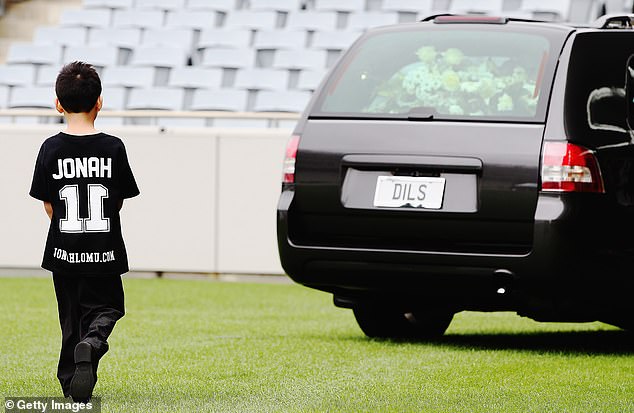
Lomu’s son, Dhyreille, follows the hearse as his father’s life was honoured at a public memorial at Eden Park in 2015
‘It just did something for him personally. He loved the game. He really stayed true to it until the end.’
FitzGerald has made documentaries about subjects as diverse as Conor McGregor and Oasis front man Liam Gallagher. But Lomu, he reckons, is a special case.
‘It was so refreshing to work on someone who, by the end of the project, I loved more in a way,’ he adds. ‘Not having him around has complications, but it’s a lot more interesting because people are really ready to tell the truth about him.
‘Jonah did pretty well, all things considered, to always remain respectful, humble, because it (the fame) can go to your head.
‘There’s a lot of conflict and vulnerabilities going on inside that head. It must have been really hard to be him. He was just so scrutinised from all sides. But he remained this humble, respectful and pleasant big friendly giant until the end.’
■ The UK premiere of Lomu takes place at the Glasgow Film Theatre on Friday, February 27, at 6pm, as part of the Glasgow Film Festival. It is also screening on Saturday, February 28 at 1.15pm.