
The Ukrainian luge team emotionally protested the disqualification of their compatriot, skeleton athlete Vladyslav Heraskevych, following their run at the Winter Olympics on Thursday.
Heraskevych was controversially kicked out of the Milan-Cortina games after refusing to replace a helmet depicting victims of the Russian invasion.
His expulsion came less than an hour before he was due to compete as a serious medal contender in Cortina with the International Olympic Committee refusing to offer any leeway to their rules around political messaging.
In the wake of Heraskevych’s controversial disqualification, his Ukrainian teammates showed their support with an act of defiance.
The country’s luge team competed in the team relay event on Thursday evening, just hours after their compatriot’s disqualification was confirmed.
The team gathered at the bottom of the track after their women’s double pairing of Olena Stetskiv and Oleksandra Mokh came through the gate and made a united gesture in support of Heraskevych.
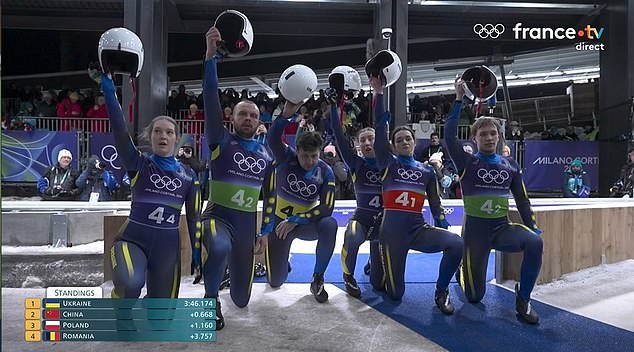
The Ukrainian luge team protested the disqualification of compatriot Vladyslav Heraskevych
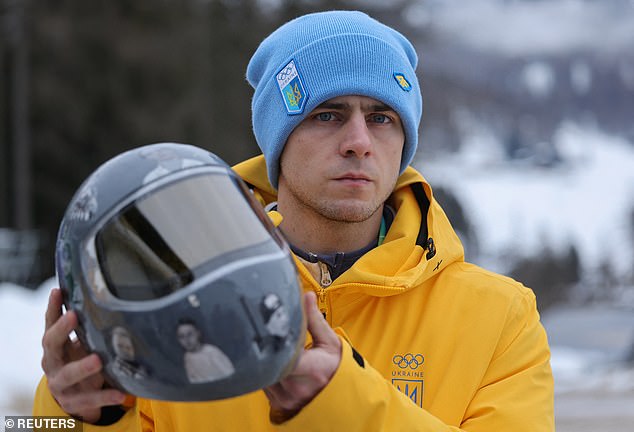
The skeleton competitor was banned from competing at the Winter Olympics after he refused to back down from wearing a helmet that featured images depicting victims of the Russian invasion of Ukraine
The six Ukrainian athletes all took the knee and held up their helmets in an apparent protest of Heraskevych’s expulsion.
The IOC released a statement at 8.10am local time announcing Heraskevych’s disqualification following ‘one final opportunity.’
‘The decision followed his refusal to comply with the IOC’s guidelines on athlete expression. It was taken by the jury of the International Bobsleigh and Skeleton Federation (IBSF) based on the fact that the helmet he intended to wear was not compliant with the rules,’ the statement read.
‘The International Olympic Committee has therefore decided with regret to withdraw his accreditation for the Milano Cortina 2026 Games.’
It added: ‘Despite multiple exchanges and in-person meetings between the IOC and Mr Heraskevych, the last one this morning with IOC President Kirsty Coventry, he did not consider any form of compromise.
‘The IOC was very keen for Mr Heraskevych to compete. This is why the IOC sat down with him to look for the most respectful way to address his desire to remember his fellow athletes who have lost their lives following Russia’s invasion of Ukraine. The essence of this case is not about the message, it is about where he wanted to express it.
‘Mr Heraskevych was able to display his helmet in all training runs. The IOC also offered him the option of displaying it immediately after the competition when going through the mixed zone.
‘Mourning is not expressed and perceived in the same way everywhere in the world. In order to support athletes in their mourning, the IOC has put in place multifaith centres in the Olympic Villages and a place of mourning, so that grief can be expressed with dignity and respect. There is also the possibility to wear a black armband during competition under certain circumstances.
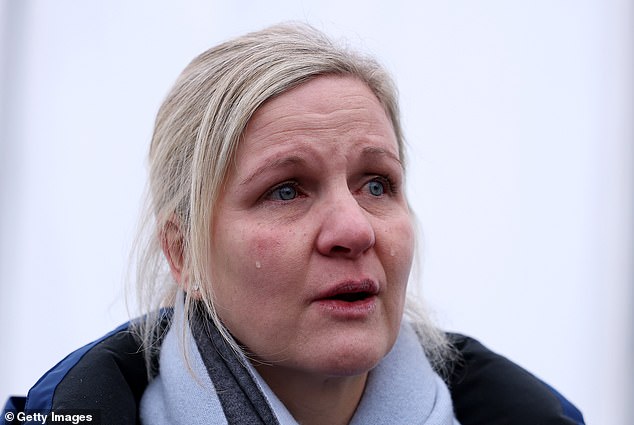
IOC president Kirsty Coventry (pictured) choked up as she faced reporters, explaining that ‘she really wanted Heraskevych to race’ before stating that it had been an ’emotional morning’
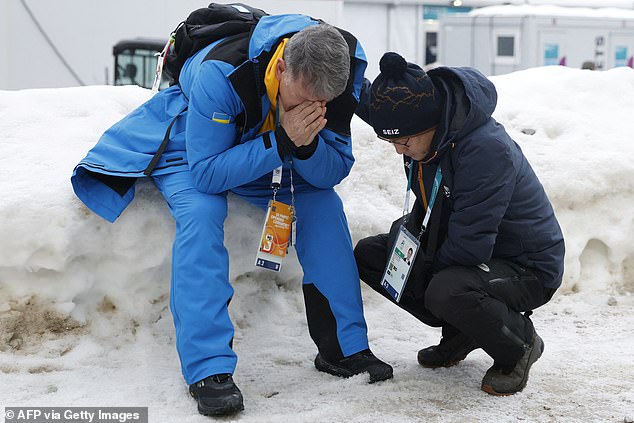
Mykhailo Heraskevych (left), Vladyslav’s father and coach, was devastated upon learning of the news
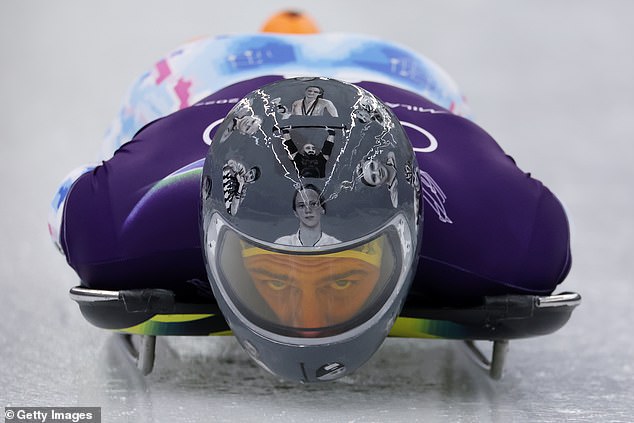
Heraskevych had arrived to speak to members of the media with the helmet. He said: ‘Even though the IOC wants to betray the memories of these athletes, I will not betray them’
‘During the Olympic Games, athletes are also offered a number of opportunities to mourn and express their views, including in the media mixed zones, on social media, during press conferences and in interviews.’
IOC president Kirsty Coventry had made one last-ditch attempt on Thursday morning to persuade Heraskevych – who has family fighting on the frontline – to end the stand-off, but with neither party willing to budge, the 27-year-old had his accreditation stripped.
Coventry choked up as she told reporters that it had been an ’emotional morning’.
‘I was not meant to be here, but I thought it was really important to come here and talk to him face to face. No one, especially me, is disagreeing with the messaging, it’s a powerful message, it’s a message of remembrance, of memory,’ the IOC president said.
‘The challenge was to find a solution for the field of play. Sadly, we’ve not been able to find that solution. I really wanted to see him race. It’s been an emotional morning.’
Heraskevych’s immediate response was to post on social media: ‘This is the price of our dignity.’
The Ukrainian later said: ‘I am disqualified from the race. I will not get my Olympic moment.
‘They were killed, but their voice is so loud that the IOC is afraid of them. I told Coventry that this decision plays along with Russia’s narrative.
‘I sincerely believe that it is precisely because of their sacrifice that these Olympic Games can take place at all today.
‘Even though the IOC wants to betray the memory of these athletes, I will not betray them.’
It is a desperately sad end to an astonishing saga and Heraskevych, the flag bearer for Ukraine at last week’s opening ceremony, will doubtless be lauded for giving up his medal prospects on a hugely evocative point of principle.
In heartbreaking scenes, Heraskevych’s father and coach, Mykhailo, was also seen perched on a mound of snow crying, after learning of the news.